


Contents
- 1 How Removable Insulation Jackets Reduce Heat Loss and Improve Energy Efficiency
- 2 Commercial Benefits: Lower Operating Costs, Faster Payback, and Long-Term Savings
- 3 Safety, Maintenance, and Reusability Benefits for Plant Operations
- 4 EcoClad’s Technical Structure and Custom Engineering Advantages
- 5 Applications and Industries That Benefit Most from Removable Insulation Jackets
- 6 ESG, Tested Quality, Documentation, and Why EcoClad Is a Reliable Choice
The biggest benefit of a removable insulation jacket is not simply keeping equipment hot. It is helping industrial plants reduce heat loss, lower operating costs, improve workplace safety, simplify maintenance, and support measurable energy-saving initiatives.
If you already understand what a removable insulation jacket is, the next question becomes much more practical: What value does it actually deliver to daily plant operation? This guide answers that question from both technical and business perspectives. It explains how removable insulation jackets improve energy efficiency, where the savings come from, and why many facilities use them as part of their maintenance and ESG strategy.
Whether you are a plant manager, maintenance engineer, energy manager, or EHS professional, the goal is the same—making insulation investments based on measurable performance rather than assumptions.

Reducing heat loss is only one part of the value. In industrial plants, removable insulation jackets also help lower energy costs, improve workplace safety, simplify maintenance, and support measurable ROI. Learn more about removable insulation jackets applications
How Removable Insulation Jackets Reduce Heat Loss and Improve Energy Efficiency
Removable insulation jackets improve energy efficiency by reducing heat loss from exposed industrial equipment. Instead of allowing valuable process heat to escape into the surrounding environment, the insulation forms a thermal barrier that helps retain heat where it is needed.
Heat Loss from Uninsulated Industrial Equipment
Uninsulated hot components are a constant source of energy loss in industrial plants, especially where traditional insulation is hard to apply or maintenance access is needed.
- Steam valves, control valves, steam traps, flanges, elbows, boiler covers, heat exchangers, and condensate equipment are often left exposed.
- Heat escapes mainly through radiation and convection.
- The loss is continuous during operation, so small exposed areas add up across many assets.
- In steam systems, even one uninsulated surface can create measurable annual energy waste.
In short, the more exposed hot components a plant has, the more heat and money it loses.
 | FLANGE INSULATION JACKET
|
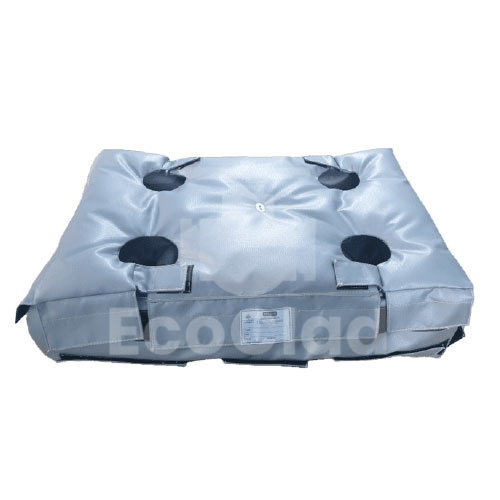 | HEAT EXCHANGER INSULATION JACKET
|
How the Jacket Creates a Thermal Barrier
A removable insulation jacket reduces heat loss by wrapping the equipment in a custom-fit thermal barrier that slows heat transfer to the surrounding air.
- It must fit tightly to avoid air gaps and thermal bridges.
- It should follow irregular shapes like valves, flanges, elbows, and actuators.
- It must still allow access for inspection and maintenance.
- Secure fastening is important to keep performance stable during operation.
In practice, custom-made jackets perform better because they match the equipment more accurately.
Before-and-After Energy Performance
The benefit becomes clear when heat loss is measured before and after installation.
- An uninsulated DN80 globe valve may lose about 919 W.
- After installing an EcoClad removable insulation jacket, heat loss can drop to about 92 W.
- Actual savings depend on temperature, ambient conditions, operating hours, insulation thickness, and installation quality.
- These figures should be used as a performance example, not a universal guarantee.
This shows that insulation is not just a general claim; it can deliver measurable energy reduction in real plant conditions.

Commercial Benefits: Lower Operating Costs, Faster Payback, and Long-Term Savings
Removable insulation jackets help reduce operating costs by minimizing unnecessary heat loss. When less thermal energy escapes from the system, less fuel is required to maintain the same process temperature, allowing the insulation investment to generate measurable savings over time.
Lower Fuel and Energy Consumption
Reducing heat loss directly reduces the amount of energy the heating system must replace. This is why insulation is often evaluated as an energy-efficiency measure rather than simply a protective cover.
Key commercial benefits include:
- Less heat escapes from steam valves, steam traps, flanges, heat exchangers, and other exposed hot equipment.
- Boilers or heating systems consume less fuel to compensate for thermal losses.
- Lower fuel consumption can reduce overall production costs, especially in steam-intensive processes.
- Energy savings become more noticeable when equipment operates continuously or at high temperatures.
Removable insulation jackets generally provide the highest return in applications with:
- Continuous 24/7 operation.
- High operating temperatures.
- Steam or thermal oil systems.
- Expensive energy sources such as LPG, diesel, biomass, or electricity.
- Large numbers of exposed valves and fittings throughout the plant.
Wanted to see more ours solutions for insulation jackets? » https://ecoclad.vn/en/danh-muc-san-pham/removable-insulation-jackets/
Practical Cost-Saving Examples
Energy savings can be estimated from measured heat-loss reduction and actual plant operating conditions.
Examples from calculated project data include:
- A DN200 valve can help save up to approximately 37 million VND per year under suitable operating conditions.
- A DN15 valve can help save more than approximately 4 million VND per year under suitable operating conditions.
Actual savings depend on several factors, including:
- Operating temperature.
- Annual operating hours.
- Fuel or energy price.
- Equipment surface condition.
- Insulation thickness and material.
- Installation quality and jacket fit.
These figures should be considered engineering estimates or project-based calculations rather than guaranteed savings. In practice, each facility should evaluate potential savings based on its own operating conditions and energy costs.
Fast ROI and One-Time Investment Value
A removable insulation jacket should be viewed as a long-term cost-control solution rather than a one-time insulation expense.
Compared with repeatedly replacing damaged conventional insulation, a reusable jacket can continue delivering value throughout multiple maintenance cycles.
Typical long-term economic benefits include:
- Reduced fuel and energy consumption.
- Lower maintenance cost because insulation can be removed and reinstalled instead of replaced.
- Less insulation material waste after maintenance work.
- Reusable design that supports repeated inspection and repair activities.
- Lower total ownership cost over the service life of the equipment.
- Payback that can be achieved within months for suitable high-temperature and continuously operated applications.
Because every plant has different operating conditions, the most reliable way to estimate return on investment is to perform a heat-loss assessment before installation. Measuring equipment temperature, operating hours, and energy costs allows the expected savings and payback period to be calculated with greater confidence.
If you are evaluating insulation for an existing plant, a site survey and heat-loss assessment can help identify which equipment offers the highest potential return before any investment is made.
 | PRESSURE REDUCING VALVE INSULATION JACKET
|
Safety, Maintenance, and Reusability Benefits for Plant Operations
Removable insulation jackets improve plant operation by increasing personnel safety while making routine maintenance faster and more practical. Unlike permanent insulation, they can be removed and reinstalled without damaging the insulation system.
Lower Surface Temperature and Improved Operator Safety
Reducing the external surface temperature helps lower burn hazards around high-temperature equipment and creates a safer working environment.
Common safety benefits include:
- Reduces the external surface temperature of hot equipment by limiting heat transfer to the surrounding environment.
- Lowers the risk of accidental contact burns around frequently accessed equipment.
- Reduces radiant heat, making work areas more comfortable for operators and maintenance personnel.
- Supports EHS initiatives by minimizing exposure to unprotected hot surfaces.
These benefits are particularly valuable around:
- Steam valve stations.
- Steam traps.
- Boiler rooms.
- Pipe racks and platforms.
- Heat exchangers.
- Maintenance walkways and inspection areas.
The actual outer surface temperature depends on equipment temperature, insulation thickness, ambient conditions, and jacket construction. Therefore, surface temperature should always be evaluated based on the specific application rather than assuming a fixed value.
Easy Removal for Inspection and Repair
One of the main advantages of removable insulation jackets is maintaining full access to equipment that requires regular maintenance.
Industrial components commonly requiring periodic access include:
- Steam traps for performance inspection.
- Y-strainers for cleaning.
- Control valves for adjustment.
- Flanges for leakage inspection.
- Boiler access covers and manholes.
- Heat exchangers for servicing.
With conventional insulation:
- Insulation often needs to be cut or removed.
- Damaged insulation may not be reinstalled correctly.
- Thermal performance gradually decreases after repeated maintenance.
With removable insulation jackets:
- The jacket can be removed without damaging the insulation.
- Maintenance can be completed without cutting insulation material.
- The same jacket can be reinstalled after inspection or repair.
- Insulation performance remains more consistent throughout the equipment life cycle.
This approach reduces maintenance downtime while helping preserve insulation quality.
Reusable Design for Multiple Maintenance Cycles
A removable insulation jacket is designed for repeated installation and removal throughout the equipment’s maintenance life.
The reusable design provides several operational advantages:
- Reduces repeated replacement of insulation materials.
- Lowers insulation waste generated during maintenance.
- Maintains more consistent thermal performance over multiple maintenance cycles.
- Reduces long-term insulation ownership cost.
- Supports more sustainable maintenance practices.
Long-term durability depends on several engineering factors, including:
- Appropriate insulation material selection.
- Heat-resistant stitching.
- Reinforced edge construction.
- Reliable fastening systems.
- Proper installation and handling by maintenance personnel.
When these factors are considered during design, the jacket can continue performing effectively through repeated maintenance activities.
 | STEAM MOISTURE SEPARATOR INSULATION JACKET
|
EcoClad’s Technical Structure and Custom Engineering Advantages
The performance of a removable insulation jacket depends not only on the insulation material but also on its engineering design, construction quality, and equipment fit. EcoClad is designed as a custom-engineered insulation system rather than a standard fabric cover.
Three-Layer Insulation Structure
EcoClad uses a three-layer construction to balance thermal insulation, durability, and serviceability.
The structure typically consists of:
- Outer layer: Silicone-coated fiberglass fabric that provides water resistance, flame resistance, abrasion resistance, and protection against industrial environments.
- Middle insulation core: High-density Rockwool insulation, typically 80 kg/m³ with a 50 mm thickness, designed to reduce heat transfer.
- Inner layer: Heat-resistant fiberglass fabric positioned directly against the equipment surface.
Standard construction is suitable for equipment operating up to 260°C, while higher-temperature configurations can be selected according to project requirements and process conditions.
Heat-Resistant Stitching and Fastening System
Insulation performance depends on more than insulation thickness alone. The mechanical construction of the jacket also affects durability, sealing performance, and ease of maintenance.
Important design features include:
- Heat-resistant sewing thread.
- Reinforced edge binding.
- High-strength fastening belts.
- Drawcord systems.
- Industrial-grade Velcro.
- Hooks and buckles where required.
- Reinforced openings around instruments and operating components.
These features help the jacket:
- Maintain its shape during operation.
- Resist repeated installation and removal.
- Simplify maintenance activities.
- Maintain stable insulation coverage over time.
This engineering approach distinguishes a removable insulation jacket from a simple fabric enclosure.
Custom-Made Design for Real Equipment Conditions
Industrial equipment rarely shares the same dimensions or maintenance requirements. For this reason, each insulation jacket should be designed according to the actual installation conditions.
A custom-designed jacket considers:
- Equipment geometry.
- Operating temperature.
- Maintenance frequency.
- Available installation space.
- Access requirements.
- Surrounding piping and structural constraints.
A properly engineered jacket should not obstruct:
- Pressure gauges.
- Drain points.
- Inspection covers.
- Bolted connections.
- Cleaning and maintenance access points.
This custom-engineering approach allows complex industrial equipment to be insulated without reducing accessibility, making removable insulation jackets suitable for equipment where conventional insulation is often impractical.
Applications and Industries That Benefit Most from Removable Insulation Jackets
Removable insulation jackets deliver the highest value on equipment that operates at high temperatures and requires regular maintenance. These applications typically experience greater heat loss, higher maintenance frequency, and faster return on investment after insulation.
High-ROI Equipment Applications
The following equipment types often provide the greatest operational and energy-saving benefits when insulated with removable jackets.
| Equipment | Primary Benefit |
| Steam valves | High surface temperature and continuous heat loss during operation. |
| Globe valves | Complex body shape makes permanent insulation difficult while maintaining accessibility. |
| Control valves | Requires periodic adjustment and actuator maintenance without damaging insulation. |
| Steam traps | Frequent inspection and performance testing require easy removal and reinstallation. |
| Y-strainers | Simplifies routine cleaning while maintaining insulation performance. |
| Blind flanges | Reduces unnecessary heat loss from exposed flange surfaces. |
| Pipe elbows | Covers irregular geometry where conventional insulation often leaves gaps. |
| Boiler covers and manholes | Allows maintenance access while reducing heat loss from removable access panels. |
| Plate heat exchangers | Improves heat retention without restricting service access. |
| Condensate pump stations | Helps maintain condensate temperature and reduces energy loss. |
| Steam flow meters | Maintains thermal stability while preserving access for calibration and inspection. |
| Brew kettles | Improves process temperature stability and reduces radiant heat. |
| Injection molding barrels | Reduces heat loss and helps maintain more consistent processing temperatures. |
| High-temperature process equipment | Improves energy efficiency while protecting personnel from exposed hot surfaces. |
In general, removable insulation jackets provide the greatest benefit where equipment has one or more of the following characteristics:
- High operating temperature.
- Continuous operation.
- Irregular or complex geometry.
- Frequent inspection or maintenance.
- Significant exposed surface area.
- Potential burn hazards for personnel.
Contact EcoClad to request a site survey and custom removable insulation jacket design for your industrial equipment.
Industrial Sectors with Strong Application Potential
Many industries operate high-temperature equipment where removable insulation can improve both energy efficiency and maintenance efficiency.
Typical applications include:
- Textile dyeing and garment manufacturing – Steam distribution systems, dyeing equipment, and heat exchangers.
- Food and beverage processing – Steam pipelines, cooking vessels, pasteurization equipment, and processing tanks.
- Breweries – Brew kettles, steam valves, and heat exchangers.
- Pharmaceutical, chemical, and cosmetic manufacturing – Process vessels, reactors, steam systems, and control valves.
- Paper, packaging, and printing – Steam-heated process equipment and drying systems.
- Seafood and agricultural processing – Boilers, steam piping, and thermal processing equipment.
- Wood pellet plants – Steam generation and biomass heating systems.
- Boiler houses – Valves, steam traps, flanges, and boiler access covers.
- HVAC systems – Heat exchangers, valves, and hot water distribution equipment.
- Wastewater treatment plants – Steam equipment used in sludge treatment and thermal processes.
- Fire protection systems – Selected heated process equipment where insulation supports stable operating conditions.
Although operating conditions differ between industries, the engineering principle remains the same: equipment that loses heat and requires regular maintenance is generally a suitable candidate for removable insulation.
When Removable Insulation Is Better Than Permanent Insulation
The selection depends primarily on maintenance requirements rather than insulation performance alone.
Permanent insulation is generally more suitable for:
- Straight pipe runs.
- Long sections of piping.
- Equipment that rarely requires inspection or disassembly.
Removable insulation jackets are generally more suitable for:
- Steam valves.
- Globe and control valves.
- Steam traps.
- Y-strainers.
- Flanges and blind flanges.
- Boiler manholes and access covers.
- Plate heat exchangers.
- Other equipment requiring periodic inspection, cleaning, adjustment, or repair.
As a practical guideline, if insulation must be removed repeatedly during normal maintenance, a removable insulation jacket usually provides a more efficient long-term solution than conventional permanent insulation.
ESG, Tested Quality, Documentation, and Why EcoClad Is a Reliable Choice
A removable insulation jacket provides value beyond energy saving by supporting ESG objectives, documented product quality, and engineering requirements commonly found in industrial projects. These factors are often considered during equipment upgrades, energy audits, and investment evaluations.

Environmental and ESG Benefits
Reducing heat loss is not only an energy-efficiency measure but also a practical way to support sustainability objectives.
From an ESG perspective, the benefits can be summarized as follows:
Environmental
- Reduces unnecessary heat loss from industrial equipment.
- Lowers overall energy consumption.
- Helps reduce fuel-related greenhouse gas emissions.
- Supports energy conservation initiatives within the plant.
Social
- Reduces external surface temperature on hot equipment.
- Lowers the risk of accidental contact burns.
- Improves workplace safety around steam systems and high-temperature equipment.
- Supports EHS programs by reducing operator exposure to radiant heat.
Governance
- Provides measurable energy-saving actions that can be documented.
- Supports internal energy management programs.
- Contributes technical evidence for sustainability reporting.
- May support broader initiatives such as Net Zero roadmaps, CBAM preparation, ISO 14001 environmental management, and GHG emission reporting where applicable.
Although removable insulation alone does not achieve ESG targets, it can become one measurable component within a broader energy management strategy.
Tested Heat Resistance and Material Stability
Engineering decisions should be supported by test data whenever possible.
EcoClad insulation materials have been tested by QUATEST 3 under controlled conditions.
According to the available test results:
- Sample tested at 260°C for 12 hours.
- No ignition was observed during testing.
- No flame propagation occurred.
- No significant deformation was reported.
- Measured mass change after testing was approximately 6%.
These test results provide technical evidence of material stability under elevated temperatures. However, actual service performance should always be evaluated according to equipment operating conditions, installation quality, and maintenance practices.
Technical Documentation and Project Handover
Industrial insulation projects often require technical documentation as part of procurement, commissioning, maintenance, or regulatory compliance.
Depending on project requirements, EcoClad can provide documentation such as:
- Certificate of Quality (CQ).
- Factory Release Certificate for each production batch.
- Internal inspection and quality control records.
- Material and technical documentation.
- Test certificates where applicable.
- Project documentation for bidding or export requirements.
- Post-installation energy-saving reports when requested.
Providing complete documentation helps engineering teams simplify equipment approval, project handover, maintenance records, and future asset management.
Why Choose EcoClad Removable Insulation Jackets
Selecting a removable insulation jacket should be based on engineering capability, manufacturing quality, and long-term serviceability rather than insulation material alone.
EcoClad is designed to support industrial applications through:
- International-standard insulation materials.
- Technical consultation based on actual operating conditions.
- On-site survey and equipment measurement.
- Custom-made design for each equipment geometry.
- CNC-supported manufacturing for dimensional accuracy.
- Capacity for both small and large production volumes.
- Documentation suitable for industrial and export projects.
- Delivery and on-site installation support.
- 24-month technical warranty.
For facilities planning to reduce heat loss or improve maintenance efficiency, a site survey and heat-loss assessment provide the most reliable basis for selecting suitable insulation solutions.
Contact EcoClad to arrange a site survey, evaluate heat-loss opportunities, and develop a custom removable insulation jacket solution that matches your industrial equipment and operating conditions.