


Contents
What Are Removable Insulation Jackets?
Removable Insulation Jacket (also known as an insulation blanket or thermal blanket) is a removable insulation layer custom-designed for each piece of equipment, helping to retain heat, reduce energy loss, protect operators, and still allow easy removal and reinstallation when maintenance is required.
At EcoClad, we see removable insulation jackets as more than just a cover. A well-designed jacket must fit properly, withstand actual operating temperatures, maintain its shape after repeated use, and avoid blocking important areas such as nameplates, handwheels, drain points, gauges, or inspection access. In short, design is just as important as the insulation material.

How Do Removable Insulation Jackets Work?
Removable insulation jackets work by creating a thermal barrier between the hot equipment surface and the surrounding environment. The jacket normally includes multiple layers:
- An outer protective layer to resist weather, moisture, oil mist, abrasion, or plant conditions.
- An insulation core to slow down heat transfer.
- An inner heat-resistant layer that faces the hot surface.
- A fastening system such as Velcro, hooks, belts, buckles, or drawcords to keep the jacket tight and removable.
When installed correctly, the insulation jacket reduces heat escaping from the equipment surface. This helps retain process heat, lower radiant heat in the working area, reduce energy waste, and improve operator safety.
Removable Insulation vs. Permanent Insulation

» Casestudy: Completion of EcoClad Thermal Insulation Jackets Installation at an F&B Processing Plant
Why Industrial Equipment Needs Removable Insulation
Heat Loss
- Hot equipment loses heat through radiation and convection when left uninsulated
- Common loss points: valves, flanges, steam traps, heat exchangers
- Leads to wasted thermal energy before it is used in production
- Removable Insulation Jacket creates a thermal barrier to reduce heat escape
- Result: improved thermal stability and lower energy demand

High Energy Costs
- Heat loss forces boilers and heating systems to work harder
- Increases fuel consumption, electricity use, and operating costs
- Affects steam, thermal oil, hot water, and high-temperature systems
- Insulation becomes part of energy management, not just maintenance
- Result: continuous energy savings after one-time installation
Unsafe Hot Surfaces
- Exposed hot equipment creates burn risks for operators and technicians
- High-risk areas: walkways, platforms, service zones, control points
- Accidental contact can lead to serious injury
- Removable jackets reduce external surface temperature
- Result: safer working environment with reduced human risk
Maintenance Difficulties
- Equipment often left uninsulated due to maintenance access concerns
- Fixed insulation may be damaged and not reinstalled after servicing
- Leads to recurring heat loss at critical points
- Removable jackets allow quick removal and reinstallation
- Result: easier maintenance without sacrificing insulation performance
» Industry knowledge: Installation of Thermal Insulation for Boiler Burners and Boiler Manholes
Carbon Emissions
- Energy loss increases fuel consumption and CO₂ emissions
- Reducing heat loss directly improves energy efficiency
- Supports ESG, decarbonization, and sustainability goals
- Removable jackets provide a practical, equipment-level solution
- Result: measurable emission reduction without complex upgrades
Equipment Exposed to Weather
- Outdoor equipment faces rain, UV, wind, and humidity
- Poor insulation can absorb moisture and lose effectiveness
- Common outdoor assets: valves, traps, flanges, tanks, heat exchangers
- Removable jackets use weather-resistant outer layers and secure fastening
- Result: durable insulation performance in harsh environments
Production Downtime
- Heat loss can destabilize process temperature
- Damaged insulation increases maintenance time
- Unsafe conditions may delay operations
- Wet or degraded insulation requires replacement
- Removable jackets maintain thermal control while allowing fast access
- Result: more stable operation and improved plant efficiency
» Need to reduce heat loss on valves, flanges, steam traps, or heat exchangers? Contact EcoClad to assess your equipment and design custom EcoClad Removable Insulation Covers for your plant.
Where Are Removable Insulation Jackets Used?
Removable Insulation Jackets are used on high-temperature industrial equipment that still requires regular access for inspection, operation, or maintenance.
They are most effective on components with irregular shapes, moving parts, or access points where permanent insulation would need to be removed and often not properly restored, causing repeated heat loss.
Valves
Common valve applications include:
- Gate Valve
- Globe Valve
- Ball Valve
- Butterfly Valve
- Check Valve
- Pressure Reducing Valve
- Control Valve
- Steam Valve
 | GLOBE AND CONTROL VALVE INSULATION JACKET
|
A removable valve jacket is designed to fit the valve shape while keeping key access points open. It reduces heat loss without affecting operation, inspection, or maintenance.
Steam Systems
Common steam system applications include:
- Steam Trap
- Y Strainer
- Moisture Separator
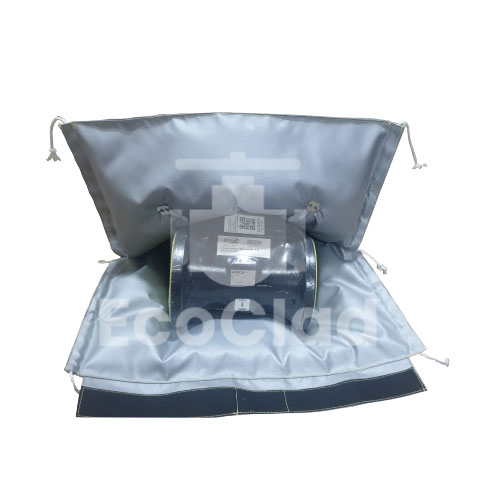 | FLOAT STEAM TRAP INSULATION JACKET
|
Steam Trap helps remove condensate and must be checked regularly to avoid steam loss or blockage. A removable jacket reduces heat loss while allowing quick inspection and replacement.
Y Strainer filters debris and requires periodic cleaning. The jacket covers the hot body but allows easy access to the cleaning cap.
Moisture Separator removes water from steam to improve quality. Insulation helps maintain temperature and reduce radiant heat around the equipment.
Heat Transfer Equipment
Common applications include:
- Heat Exchanger
- Boiler
- Condensate Tank
- Pipe
 | PLASTIC INJECTION MOLDING MACHINE INSULATION JACKET
|
Heat Exchanger transfers heat between fluids and may need cleaning or inspection. A removable jacket allows insulation without blocking access to covers or connections.
Boiler components operate at high temperature and require inspection points to remain accessible. Removable insulation helps reduce heat loss while supporting maintenance.
Condensate Tank stores hot condensate and can lose heat through exposed surfaces. Insulation helps retain heat while allowing inspection or cleaning.
Pipe sections near valves or flanges may need frequent access. Removable insulation is suitable for these areas instead of permanent insulation.
Removable Insulation Jackets help industrial plants reduce heat loss, save energy, lower operating costs, improve workplace safety, and maintain equipment access for service.
Key Benefits of Removable Insulation Jackets
Reduce Heat Loss
- Covers exposed hot surfaces with a custom-fit thermal barrier
- Reduces heat loss (radiation & convection) by up to ~90% depending on conditions
- Improves heat retention and stabilizes process temperature
- Minimizes radiant heat and reduces load on heating systems
Save Energy
- Reduces energy required to maintain system temperature
- Recovers wasted heat from valves, traps, flanges, and exchangers
- Most effective for high-temperature, continuous-operation equipment
- Supports lower boiler load and improved system efficiency
Reduce Operating Costs
- Lowers fuel and energy consumption
- Eliminates repeated insulation repair after maintenance
- Reduces labor, downtime, and material waste
- Best ROI on high-temp, frequently accessed components
Improve Workplace Safety
- Lowers external surface temperature of hot equipment
- Reduces burn risk for operators and maintenance staff
- Decreases radiant heat in working areas
- Requires secure fit and proper fastening for safe operation
Easy Maintenance
- Can be removed and reinstalled without damage
- Supports quick access to valves, traps, strainers, flanges, etc.
- Designed to match real maintenance workflows
- Reduces service time and improves reinstallation consistency
Reusable
- Designed for multiple removal and installation cycles
- Reduces need for replacement insulation materials
- Suitable for equipment with frequent inspection needs
- Requires proper design, handling, and material selection
Reduce CO₂ Emissions
- Lowers energy consumption by reducing heat loss
- Supports reduction of fuel-related emissions
- Effective for continuous high-temperature operations
- Provides measurable impact for energy and carbon tracking
Support ESG Goals
- Environmental: reduces energy waste and CO₂ emissions
- Social: improves workplace safety by lowering surface temperature
- Governance: supports consistent insulation and maintenance practices
- Enables measurable reporting for energy efficiency and sustainability programs
EcoClad Materials & Construction
EcoClad Removable Insulation Covers are built with layered materials selected to match temperature, environment, mechanical handling, and maintenance frequency.
| Component | Typical Material | Main Function | Engineering Notes |
| Outer Layer | Silicone-coated fiberglass | Protects the Insulation Cover from moisture, weather, abrasion, and plant conditions | Suitable for flexible insulation covers; material selection should consider indoor/outdoor exposure |
| Insulation Core | High-density Rockwool | Reduces heat transfer and supports thermal insulation performance | Density and thickness should be selected based on temperature, surface area, and required performance |
| Inner Layer | High-temperature resistant fabric | Faces the hot equipment surface and protects the insulation core | Must be compatible with actual operating temperature and surface condition |
| Fastening System | Velcro, hook, belt, buckle | Keeps the Thermal Blanket closed while allowing removal and reinstallation | Selection depends on size, equipment shape, vibration, and maintenance frequency |
| Reinforcement | Edge binding, stitching, reinforced openings | Maintains Insulation Blanket shape and improves durability | Important for repeated removal, outdoor use, and complex equipment shapes |
Why Choose EcoClad by EcoClad?
EcoClad by EcoClad is developed for industrial equipment that requires both thermal insulation performance and practical maintenance access. The main value comes from custom engineering, suitable material selection, and manufacturing flexibility for real plant conditions.
Custom Design: Each insulation cover is designed based on the actual equipment shape, operating condition, and access requirement. This helps reduce heat-loss gaps and avoids blocking important maintenance points.
Direct Site Survey: EcoClad engineers conduct site surveys to check equipment dimensions, installation space, surface temperature, and surrounding constraints. This reduces fitting errors and ensures the insulation cover matches the real operating environment.
Engineered for Every Equipment: EcoClad is not produced as a generic cover. Each jacket is engineered for specific equipment such as valves, flanges, steam traps, heat exchangers, boilers, pumps, or turbines.
Tailor-Made Manufacturing: Every cover is made to match the measured dimensions of each asset. This is especially important for irregular equipment shapes, limited installation space, or components with actuators, gauges, drains, and handwheels.
High-Quality Materials: EcoClad uses technical insulation materials such as high-density Rockwool and silicone-coated fiberglass. Material selection is based on temperature, exposure condition, durability requirement, and maintenance frequency.
Easy Removal: The fastening system is designed for quick removal during inspection or repair. Technicians can access the equipment without cutting or damaging the insulation.
Reusable: After maintenance, the same insulation cover can be reinstalled. This reduces replacement waste and helps maintain insulation consistency over multiple maintenance cycles.
Professional Engineering Support: EcoClad provides technical support from survey, design, material selection, manufacturing, to installation guidance. This helps customers apply insulation correctly instead of treating it as a simple fabric product.
OEM Capability: EcoClad can manufacture removable insulation covers for OEM partners or equipment suppliers. Designs can be adapted to specific product lines, branding requirements, or repeated equipment models.
Flexible Manufacturing: EcoClad supports both small custom projects and larger quantity production. This flexibility is useful for plants that want to start with critical heat-loss points before expanding to the full system.
Export Experience: EcoClad’s manufacturing process can support export requirements for industrial insulation products. This includes consistent sizing, packaging, documentation, and project-based customization.
24-Month Warranty: EcoClad comes with a 24-month warranty under applicable operating and handling conditions. This reflects confidence in material selection, stitching quality, and manufacturing control.
» If your plant is looking for a practical way to reduce heat loss, improve safety, and keep maintenance access open, EcoClad Removable Insulation Covers can be designed for your specific equipment.