


Contents
- 1 What Are Flexible Insulation Blankets?
- 2 Flexible Insulation Blankets vs Removable Insulation Jackets
- 3 Where Flexible Insulation Blankets Are Used
- 4 Key Design Features of a Good Flexible Insulation Blanket
- 5 When Should You Choose Flexible Insulation Blankets?
- 6 How EcoClad Designs Custom Flexible Insulation Blankets
Industrial equipment often includes valves, flanges, steam traps, heat exchangers, and other components with irregular shapes that are difficult to insulate using conventional rigid insulation. In these situations, flexible insulation blankets provide a practical solution by conforming to complex surfaces while reducing heat loss, improving personnel safety, and allowing easier maintenance.
In industrial applications, the term flexible insulation blankets is frequently used alongside removable insulation jackets, thermal blankets, and removable insulation covers. While these terms are closely related, they may emphasize different design characteristics depending on the application. Understanding their relationship helps engineers and plant operators choose the most suitable insulation solution for their equipment.

What Are Flexible Insulation Blankets?
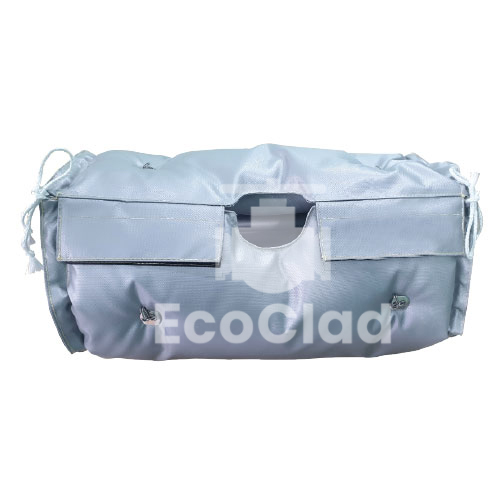
Flexible insulation blankets are soft, heat-resistant insulation systems designed to wrap around industrial equipment with complex shapes, reducing heat loss while protecting hot surfaces and maintaining accessibility.
Unlike rigid insulation boards or permanent pipe insulation, flexible insulation blankets can bend, fold, and closely follow uneven equipment geometry. This makes them suitable for components that contain flanges, valves, bolted connections, curved surfaces…
Within industrial facilities, the term generally refers to insulation products that are also known as:
- Removable insulation jackets – custom-fabricated insulation systems designed for repeated removal and reinstallation during equipment maintenance.
- Thermal blankets – a broad industry term describing flexible thermal insulation used to control heat transfer.
- Removable insulation covers – another common name emphasizing protective insulation that can be detached without damaging the equipment.
Compared with permanent insulation, flexible insulation blankets are particularly valuable for equipment requiring regular inspection or maintenance. Instead of cutting away insulation every time technicians need access, the blanket can simply be removed and reinstalled, helping preserve insulation performance while reducing maintenance time and material waste.
Flexible Insulation Blankets vs Removable Insulation Jackets
Flexible insulation blankets and removable insulation jackets are closely related, but they do not always mean the same thing. The difference mainly lies in whether the insulation is a general flexible material or a custom-engineered solution for a specific piece of equipment.
Because different manufacturers and industries use these terms interchangeably, understanding their technical meaning helps avoid confusion when selecting or specifying insulation products.

Although these terms overlap, each highlights a different characteristic of the insulation system:
- Flexible insulation blanket focuses on the ability to bend, wrap, and conform to complex equipment shapes.
- Removable insulation jacket focuses on custom engineering, tailored fabrication, and repeated removal for maintenance.
- Thermal insulation cover is a general description rather than a specific product type.
- Permanent insulation prioritizes continuous insulation performance but normally requires cutting or replacement when maintenance is needed.
From an EcoClad perspective, a removable insulation jacket is typically manufactured using the same thermal insulation principles as a flexible insulation blanket, but it incorporates additional design features such as:
- Custom dimensions based on the actual equipment.
- Patterned construction to match complex geometries.
- Reinforced stitching for long-term durability.
- Hook-and-loop straps, belts, or lacing systems for secure installation.
- Openings or removable sections for valves, gauges, drains, bolts, and other maintenance points.
In simple terms, every removable insulation jacket is built on the concept of a flexible insulation blanket, but not every flexible insulation blanket is a fully engineered removable insulation jacket.
A flexible insulation blanket becomes a removable insulation jacket when it is custom-designed, shaped, stitched, and fastened for a specific piece of industrial equipment.
Where Flexible Insulation Blankets Are Used
Flexible insulation blankets are primarily used on industrial equipment with irregular shapes or components that require frequent maintenance, where permanent insulation is difficult to install or reuse.
Unlike straight pipelines that can often be insulated with rigid or fixed materials, many industrial components include curves, bolted joints, inspection points, and moving parts. A flexible insulation system can conform to these shapes while remaining removable when maintenance is required.
Typical applications include:
| Equipment | Application / Benefit |
|---|---|
| Valves | Accommodates handwheels, actuators, and irregular valve bodies without restricting operation. |
| Flanges | Covers bolted flange connections while allowing quick access during inspection or gasket replacement. |
| Steam traps | Reduces heat loss from high-temperature condensate systems while maintaining serviceability. |
| Y-strainers | Fits around the angled body and allows the screen to be cleaned without damaging the insulation. |
| Pipe elbows | Wraps curved pipe sections that are difficult to insulate with rigid materials. |
| Boiler manholes | Provides thermal insulation while allowing access for scheduled internal inspections. |
| Heat exchangers | Conforms to channels, nozzles, covers, and support structures with complex geometries. |
| Condensate equipment | Helps retain process temperature on pumps, receivers, and condensate recovery systems that require periodic servicing. |
| Injection molding barrels | Reduces heat loss while allowing access to heaters, sensors, and maintenance points. |
| Tanks and special equipment surfaces | Fits vessels or equipment with curved, tapered, or non-standard profiles where conventional insulation cannot achieve a proper fit. |
Compared with permanent insulation, flexible insulation blankets are generally preferred when equipment has one or more of the following characteristics:
- Irregular or non-uniform geometry.
- Frequent inspection or maintenance requirements.
- Bolted covers or removable components.
- Instruments, drains, gauges, or valves that must remain accessible.
- Areas where damaged insulation would otherwise require repeated replacement after maintenance.
In these situations, flexibility is not only about following the equipment shape—it also helps preserve insulation performance over multiple maintenance cycles without repeatedly removing and replacing fixed insulation.
 | BALL VALVE INSULATION JACKET
|
 | PIPE ELBOW INSULATION JACKET
|
 | STEAM METER INSULATION JACKET
|
Discover more about our Custom-made insulation covers for industrial equipment
Key Design Features of a Good Flexible Insulation Blanket
A high-quality flexible insulation blanket combines thermal performance, mechanical durability, and easy maintenance through a multi-layer custom design.
The effectiveness of the insulation depends not only on the insulation material itself but also on how the blanket is engineered, assembled, and installed for the operating environment.
Key design features include:
- Flexible outer layer: Protects against abrasion and moisture while remaining flexible enough to conform to irregular equipment shapes.
- High-performance insulation core: Provides the main thermal barrier and reduces heat loss.
- Heat-resistant inner layer: Withstands hot surfaces and protects the insulation core from direct thermal exposure.
- Reinforced stitching: Improves durability during repeated removal and reinstallation.
- Reliable fastening system: Keeps the blanket secure during operation and allows easy removal for maintenance.
- Custom access openings: Provide access to gauges, valves, drains, bolts, and flanges without cutting the insulation.
- Water and environmental resistance: Helps the blanket perform in dirty, damp, or exposed plant conditions.
- Heat resistance: Matches the equipment’s operating temperature and thermal cycling requirements.
- Designed for repeated removal and reinstallation: Maintains fit and insulation performance over multiple maintenance cycles.
A well-designed flexible insulation blanket should not only reduce heat loss but also simplify maintenance by fitting accurately, remaining durable in industrial conditions, and maintaining consistent thermal performance throughout its service life.
When Should You Choose Flexible Insulation Blankets?
Flexible insulation blankets are the right choice when equipment requires both thermal insulation and regular maintenance access.
Instead of selecting insulation based only on operating temperature, engineers should also consider equipment geometry, maintenance frequency, and accessibility. Flexible insulation is generally recommended in the following situations:
- The equipment has an irregular shape: Suitable for valves, flanges, elbows, strainers, heat exchangers, and other non-uniform equipment where rigid insulation cannot achieve a proper fit.
- Frequent removal is required: Ideal for equipment that must be inspected, serviced, or repaired without destroying the insulation.
- Permanent insulation is repeatedly damaged: Eliminates the need to cut away and replace fixed insulation after every maintenance activity.
- Surface temperature must be reduced while maintaining access: Helps improve personnel safety without blocking access to operating handles, bolts, drains, or inspection points.
- The equipment is located in operator work areas: Reduces exposure to hot surfaces while allowing routine operation and maintenance.
- A custom-fit solution is required: Designed according to actual equipment dimensions, ensuring complete coverage and minimizing thermal gaps.
When these conditions exist, a custom flexible insulation blanket usually provides a more practical long-term solution than permanent insulation.
For projects focused on energy savings, personnel protection, and maintenance efficiency, these advantages are discussed in more detail in our Benefits of Removable Insulation Jackets guide.

How EcoClad Designs Custom Flexible Insulation Blankets
EcoClad flexible insulation blankets are engineered individually for each application, ensuring the insulation matches the equipment geometry, operating conditions, and maintenance requirements.
Rather than using standard sizes, each insulation blanket is developed through a structured engineering process:
- Site survey: Engineers inspect the equipment, surrounding installation space, and maintenance requirements before design begins.
- Equipment measurement: Actual dimensions are collected to ensure the insulation fits accurately without excessive gaps or compression.
- Operating condition assessment: Design parameters such as operating temperature, equipment type, and service environment are evaluated before material selection.
- Material selection: Outer fabric, insulation core, and inner lining are chosen according to the application’s thermal and mechanical requirements.
- Access point design: Openings and removable sections are incorporated for valves, gauges, drains, flanges, bolts, lifting points, and equipment nameplates.
- Custom manufacturing: Each blanket is cut, stitched, and assembled to match the measured equipment rather than relying on standard dimensions.
- Installation and maintenance guidance: After installation, technicians receive recommendations for proper removal, reinstallation, and routine handling to help maintain insulation performance.
Learn more about: Benefits of removable insulation jackets
The EcoClad manufacturing approach is designed to support industrial facilities that require:
- Custom-engineered insulation solutions.
- Direct site survey and field measurement.
- Tailor-made manufacturing for individual equipment.
- High-quality materials suitable for industrial operating conditions.
- Easy removal and repeated reinstallation.
- Reusable insulation systems that support long service life.
- Flexible manufacturing for both individual units and large projects.
- OEM manufacturing capability for industrial partners.
- A 24-month product warranty under specified operating and installation conditions.
By combining custom engineering with reusable construction, EcoClad flexible insulation blankets are designed to deliver consistent thermal performance while simplifying maintenance throughout the equipment’s operating life.
Need a custom flexible insulation blanket for your equipment?
Every industrial application has different operating temperatures, equipment geometry, and maintenance requirements. A properly engineered insulation blanket should be designed around the actual equipment rather than selected from standard sizes.
If you’re evaluating a solution for valves, heat exchangers, steam systems, tanks, or other industrial equipment, the EcoClad engineering team can help assess your application, recommend suitable insulation materials, and develop a custom removable insulation blanket based on your operating conditions.
Contact EcoClad today to discuss your project or request a technical consultation.