

Contents
- 1 What Is a Butterfly Valve and Why Does It Need Insulation?
- 2 Common Problems Caused by Uninsulated Butterfly Valves
- 3 Engineering Design Considerations
- 4 Applications
- 5 Why Engineers Choose EcoClad
- 6 Frequently Asked Questions
- 6.1 Can the insulation jacket be removed for maintenance?
- 6.2 Will the insulation interfere with valve operation?
- 6.3 What operating temperature can the insulation withstand?
- 6.4 How long does installation take?
- 6.5 How often should the insulation be inspected?
- 6.6 Can the insulation be used outdoors?
- 6.7 Is custom sizing necessary?
- 6.8 Does the insulation absorb moisture?
Butterfly valves are widely used to isolate or regulate the flow of steam, hot water, thermal oil, and other industrial process fluids. Thanks to their compact design, low pressure drop, and quarter-turn operation, they are commonly installed throughout industrial piping systems where reliable flow control is essential.
Although butterfly valves occupy a relatively small area within a piping network, they can become significant sources of heat loss because the valve body, disc, and flanged connections are often left exposed. These surfaces continuously transfer heat to the surrounding environment through conduction, convection, and thermal radiation, reducing overall system efficiency.
Without proper insulation, facilities may experience higher fuel consumption, increased boiler loads, elevated equipment room temperatures, and greater burn risks for maintenance personnel. Since butterfly valves also require periodic inspection and operation, conventional fixed insulation is often impractical.
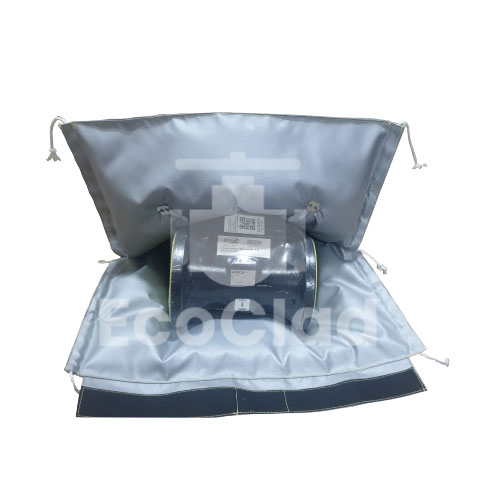
EcoClad removable insulation jackets are engineered specifically for butterfly valves, providing effective thermal insulation while allowing quick access for inspection, maintenance, and replacement without damaging the insulation.
Learn more about: Benefits of insulation jackets
What Is a Butterfly Valve and Why Does It Need Insulation?
Butterfly valves play an essential role in industrial piping systems by controlling flow with a rotating disc mounted on a central shaft. Their simple design makes them suitable for applications ranging from low-pressure water systems to high-temperature steam distribution networks.
Function of the equipment
A butterfly valve regulates or isolates fluid flow by rotating the valve disc approximately 90 degrees between fully open and fully closed positions.
They are commonly installed in:
- Steam distribution systems
- Thermal oil pipelines
- Hot water networks
- HVAC systems
- Chemical processing plants
- Food and beverage production
- Power generation facilities
Because butterfly valves are frequently operated and periodically inspected, maintaining easy access is an important consideration when selecting insulation.
Typical operating temperature
Operating conditions vary depending on the process, but butterfly valves commonly handle:
- Steam temperatures above 180°C
- Hot water systems up to approximately 120°C
- Thermal oil applications exceeding 250°C
- Pressures ranging from low-pressure utility services to high-pressure industrial systems
- Continuous or intermittent operating cycles
The combination of elevated temperatures and continuous operation makes insulation an effective method of reducing unnecessary energy losses.
Why heat loss occurs
Heat continuously escapes from an uninsulated butterfly valve through three primary mechanisms.
Conduction transfers heat through the valve body and connected piping.
Convection carries heat away as surrounding air circulates across the valve surface.
Thermal radiation emits infrared energy from the hot metal surface into the surrounding environment.
Because valves typically have larger exposed surface areas than straight pipe sections, their heat loss per unit area can be significantly higher, making them ideal candidates for removable insulation jackets.
Common Problems Caused by Uninsulated Butterfly Valves
Leaving butterfly valves uninsulated creates several operational and maintenance challenges beyond simple energy loss.
Continuous heat loss
Every exposed valve becomes a constant source of thermal energy loss.
Across an entire facility, hundreds of uninsulated valves may collectively increase:
- Boiler fuel consumption
- Steam generation demand
- Operating costs
- Energy waste
Proper insulation helps retain valuable process heat within the piping system rather than allowing it to dissipate into the surrounding environment.
Personnel burn hazards
Valve surfaces operating above safe touch temperatures present a potential burn hazard for maintenance personnel.
Insulating exposed butterfly valves helps:
- Reduce accessible surface temperatures
- Improve workplace safety
- Minimize accidental contact injuries
- Support safer maintenance practices around high-temperature equipment
This is particularly important in areas where operators routinely access valves for inspection or process adjustments.
Higher ambient temperature
Heat released from numerous uninsulated valves gradually increases the temperature inside boiler rooms, production facilities, and mechanical spaces.
Higher ambient temperatures may:
- Reduce operator comfort
- Increase ventilation requirements
- Add cooling loads in conditioned spaces
- Affect nearby equipment performance
Insulating valves helps maintain a more stable working environment.
Difficult maintenance
Maintenance technicians often need to wait until hot valves cool before safely performing inspections or repairs.
Removable insulation jackets allow the insulation to be removed and reinstalled quickly without destroying the thermal protection, reducing downtime while preserving insulation performance.
ESG and carbon emissions
Reducing heat loss contributes directly to improved energy efficiency.
Lower fuel consumption generally results in:
- Reduced greenhouse gas emissions
- Improved sustainability performance
- Lower operating costs
- Better alignment with energy management and ESG initiatives
Although insulation alone is not a complete carbon reduction strategy, it is one of the simplest improvements available for existing steam systems.
Engineering Design Considerations
Effective valve insulation depends on engineering rather than standard sizing alone. According to EcoClad engineering experience, the surrounding installation space and maintenance requirements are often more critical than the valve dimensions themselves.
Surface temperature
Insulation thickness should be selected according to operating temperature, desired surface temperature, and energy-saving objectives rather than using a single standard specification.
Clearance requirements
Nearby flanges, actuators, pipe supports, adjacent valves, and structural members influence the shape of each insulation jacket.
Adequate clearance ensures the jacket can be removed without interfering with surrounding equipment.
Valve operation
The insulation must never obstruct manual levers, gear operators, pneumatic actuators, or electric actuators. Full valve operation should remain possible with the insulation installed.
Inspection access
Routine inspection, actuator maintenance, and valve replacement should be possible without dismantling adjacent insulation.
Moisture protection
Outdoor installations require weather-resistant outer fabrics capable of resisting moisture while protecting insulation performance.
Material selection
Material selection depends on operating temperature, environmental exposure, and maintenance frequency.
Typical construction includes high-density Rockwool insulation combined with silicone-coated fiberglass fabric for durability and repeated use.
Applications
Removable butterfly valve insulation jackets are suitable for industrial facilities where both thermal efficiency and maintenance accessibility are important.
Typical applications include:
- Steam systems
- Thermal oil systems
- Hot water distribution
- Chemical processing plants
- Food and beverage manufacturing
- Pharmaceutical production
- Textile factories
- Palm oil processing
- Power plants
- Paper mills
- District heating systems
- Industrial utility networks
Because every installation differs in valve size, actuator configuration, and surrounding piping layout, insulation jackets are typically custom engineered for each application.
Why Engineers Choose EcoClad
Engineers generally evaluate insulation solutions based on long-term performance rather than initial appearance.
EcoClad insulation jackets are custom engineered for the specific valve model, actuator arrangement, operating temperature, and installation conditions. This approach provides consistent installation quality while simplifying future maintenance.
High-temperature insulation materials maintain reliable thermal performance under demanding operating conditions, while reusable fastening systems allow repeated removal without damaging the insulation. The design also preserves access for inspection and valve operation, helping maintenance teams perform routine servicing efficiently.
Rather than supplying standard insulation products, EcoClad focuses on engineering insulation systems that match the operating requirements of each butterfly valve installation.
Frequently Asked Questions
Can the insulation jacket be removed for maintenance?
Yes. The jacket is specifically designed for repeated removal and reinstallation, allowing maintenance personnel to inspect or service the butterfly valve without damaging the insulation.
Will the insulation interfere with valve operation?
No. Properly engineered insulation jackets provide sufficient clearance for manual handles, gearboxes, and actuators so normal valve operation is maintained.
What operating temperature can the insulation withstand?
The allowable operating temperature depends on the selected insulation and outer fabric materials. Material selection is determined according to the application’s temperature requirements.
How long does installation take?
Because the jacket is manufactured to match the valve geometry, installation typically requires only a few minutes using the integrated fastening system.
How often should the insulation be inspected?
Insulation should be visually inspected during scheduled equipment maintenance to verify that fasteners, seams, and outer protective fabrics remain in good condition.
Can the insulation be used outdoors?
Yes. Weather-resistant outer fabrics are available for outdoor installations where protection against rain, moisture, and environmental exposure is required.
Is custom sizing necessary?
Yes. Butterfly valves vary considerably in body dimensions, flange arrangements, actuator types, and installation clearances. Custom sizing ensures proper fit, thermal performance, and maintenance accessibility.
Does the insulation absorb moisture?
Quality insulation jackets incorporate moisture-resistant outer materials designed to minimize water penetration while protecting the insulation core. Appropriate material selection is especially important for outdoor or high-humidity environments.